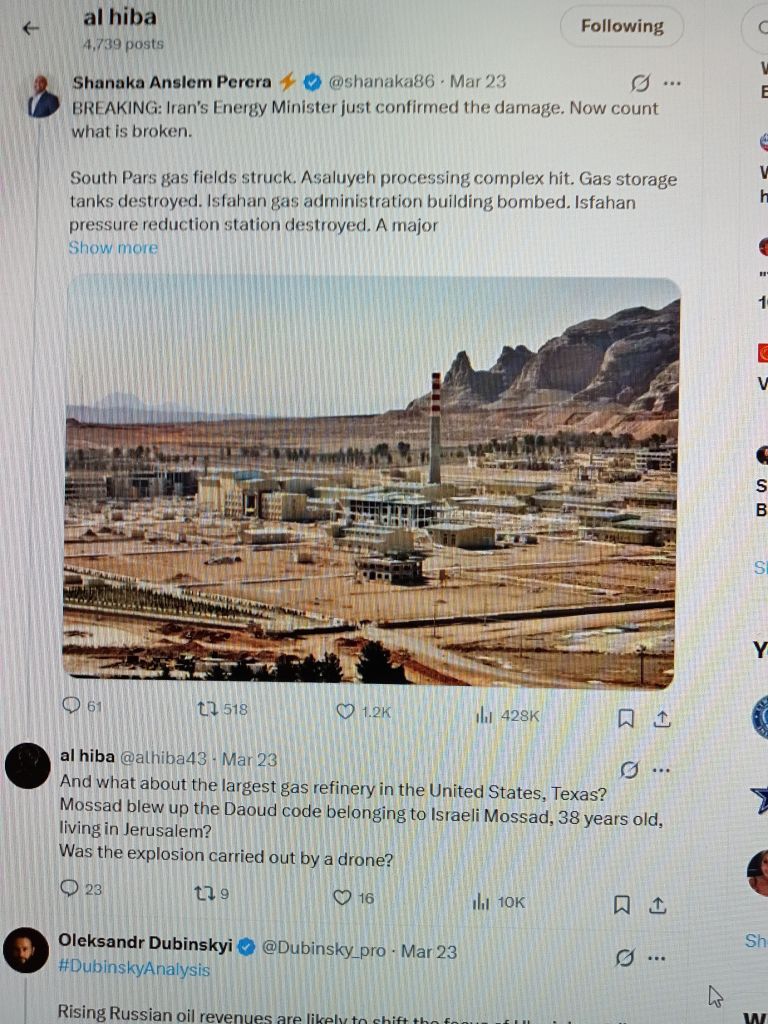
And what about the largest gas refinery in the United States, Texas? Mossad blew up the Daoud code belonging to Israeli Mossad, 38 years old, living in Jerusalem? Was the explosion carried out by a drone?
I believe a cover up is actively taking place across the mainstream media!
The post you’re seeing from “al hiba” contains several claims that align with viral information currently spreading on social media.
Official investigators and local authorities have claimed to found no evidence to support the idea of a drone attack or Mossad involvement. Here is a direct breakdown of the facts regarding the claims in that post:
1. The “Drone” and “Sabotage” Claims
There is no evidence of a drone or any external attack.
Official Investigation: The Jefferson County Sheriff’s Office and Valero have stated that the incident was an industrial accident. A report filed with the Texas Commission on Environmental Quality (TCEQ) on March 24 attributed the fire to an “unforeseeable release of process fluid” in Complex 2.+1
Law Enforcement: Chief Deputy Donta Miller explicitly stated that the department is not investigating the explosion as a deliberate act.
Source of Rumors: The “drone” theory emerged primarily from pro-IRGC social media accounts and regional news outlets like Al Mayadeen, which began pushing a sabotage narrative immediately following the blast as part of broader geopolitical tensions.
2. The “Daoud Code” / Mossad Reference
The mention of a “Daoud code” or a 38-year-old Mossad agent in Jerusalem is a common characteristic of disinformation campaigns.
Tactical Misinformation: During high-profile accidents, anonymous accounts often use specific-sounding names or “codes” to make a conspiracy theory feel more authentic or “insider-led.”
Shelter-in-Place Active OILFIELD BUSINESS NETWORK EXCLUSIVE PORT ARTHUR, Texas – A massive explosion rocked the Valero Port Arthur Refinery, the largest in the United States, early Monday evening, sparking a significant industrial fire and triggering extensive shelter-in-place orders for surrounding communities. While official sources are attributing the blast to a probable mechanical failure, the event has amplified an already volatile energy market. The Incident and Emergency Response The explosion occurred at approximately 6:30 p.m. CDT on March 23, centered in one of the refinery’s processing units. The shockwave was felt miles away, rattling windows across Port Arthur and neighboring towns like Groves and Nederland. Immediately following the blast, a substantial fire erupted, sending columns of thick, black smoke into the sky. Refinery emergency personnel, supported by mutual aid from surrounding industrial fire departments, engaged the blaze. Valero quickly confirmed that all 770 plant employees had been accounted for, and remarkably, no injuries were reported among staff. Local Impacts: Shelter-in-Place and School Closures In response to potential air quality concerns, the Port Arthur Office of Emergency Management, led by Mayor Charlotte Moses and Sheriff Zena Stephens, issued a Shelter-in-Place order. This order remains active as of Tuesday morning for the west side of Port Arthur, Sabine Pass, and Pleasure Island. Residents are advised to stay indoors, seal windows and doors, and turn off air conditioning systems until an “All Clear” is given. The order was issued primarily to prevent respiratory irritation from the heavy smoke plume. Furthermore, Sabine Pass ISD has canceled classes for Tuesday, March 24, as a direct result of the ongoing situation and travel disruptions. Major thoroughfares, including State Highways 82 and 87, experienced temporary closures, complicating traffic flow. Investigation Underway: Sabotage Claims vs. Industrial Failure The timing of this incident is particularly striking, occurring amidst extreme global oil market volatility and heightened geopolitical tensions involving Iran. Almost immediately following the explosion, online channels and social media accounts linked to Iranian interests began celebrating the event, some labeling it as a “strike” or “sabotage.” However, local and state officials have strongly push back on this narrative. Jefferson County Sheriff Zena Stephens has consistently stated that the preliminary evidence points squarely to an industrial heater malfunction as the likely cause. There is currently no confirmation from any official U.S. law enforcement or intelligence agency of external sabotage or intelligence involvement. The Texas Commission on Environmental Quality (TCEQ) is on-site with air monitoring equipment, and full investigations by Valero and relevant federal safety agencies will commence once the scene is fully secured. Market Implications and Outlook As the single largest refinery in the nation, with a total throughput capacity of 435,000 barrels per day, any prolonged disruption at the Port Arthur facility sends immediate ripples through the global energy market. Prices spikes, which were already elevated, saw further volatility following the news. Oilfield Business Network will continue to track this critical developing story. We are awaiting the official results of the TCEQ air monitoring and the formal lifting of the shelter-in-place order. While the facility’s overall operations are being assessed, the initial confirmation of zero casualties among staff is a significant relief. For continued, in-depth analysis on how this incident affects the oilfield services sector, supply chain dynamics, and regulatory responses, keep your browser tuned to OilfieldBusinessNetwork.com. high-pressure water from on-site emergency vehicles can be seen directed at the flames, illustrating the intense ongoing fire suppression efforts that characterized the immediate response. .
Lack of Evidence: No credible news agency, intelligence organization, or government official has verified the existence of a “Daoud code” or any operative linked to this event.
This report examines the feasibility of establishing a micro oil refinery in South Sudan. South Sudan possesses substantial crude oil reserves; however, its refining capacity is severely limited, leading to a heavy reliance on imported petroleum products. This study analyzes the current state of South Sudan’s oil and gas industry, the demand for refined products, the regulatory environment, the economic viability of a micro refinery, potential challenges, relevant case studies from Africa, and the availability of crude oil feedstock. The findings suggest that while there are significant opportunities due to the gap in refining capacity and the availability of crude oil, substantial challenges related to political instability, infrastructure limitations, and the regulatory environment must be carefully considered. A phased approach, focusing on meeting local demand and leveraging modular refinery technology, appears to offer the most viable path forward.
2. Introduction
South Sudan’s energy sector is characterized by a significant endowment of crude oil reserves, which form the backbone of its economy, contributing approximately 90% to its Gross Domestic Product.1 Despite this wealth in natural resources, the nation’s refining capacity remains underdeveloped, with only the Bentiu Refinery currently operational at a modest production level of around 5,000 to 10,000 barrels per day (bpd).2 This disparity forces South Sudan to import a large portion of its refined petroleum products to meet domestic needs.5 The country has expressed a clear ambition to increase its oil production and expand its refining capabilities to cater to both domestic consumption and the broader East African market.9
Globally and regionally, there is a growing interest in micro and modular refineries as effective solutions for localized crude oil processing.11 These smaller-scale refineries, with capacities typically ranging from 1,000 to 30,000 bpd, offer several advantages, including lower capital investment, quicker installation times, and the ability to be deployed in remote areas, making them particularly suitable for countries with extensive oil reserves but limited infrastructure.11 The flexibility and scalability of modular refineries can address the challenges of transportation costs and enhance energy security for local populations.11 Given South Sudan’s current infrastructure constraints and the necessity for localized fuel supplies, the implementation of a micro oil refinery presents a potential pathway to enhance energy independence and foster economic development. This study aims to provide a comprehensive analysis of the feasibility of such a project.
3. South Sudan’s Oil and Gas Industry: Current Scenario
South Sudan’s oil production is primarily concentrated in two major basins: the Muglad Basin and the Melut Basin.2 The Muglad Basin yields Nile blend and Fula blend crude oils, while the Melut Basin is the source of Dar blend crude oil.2 Nile blend is characterized as a medium, waxy crude with a high yield of fuel and gasoil, making it a desirable feedstock for refining.2 Dar blend is a heavier crude with low sulfur content but a notable high total acid number (TAN), a characteristic that can pose challenges during the refining process due to its corrosive nature at high temperatures.2 Fula blend is a highly acidic crude oil, which is currently mainly processed for domestic use.2
The transportation of South Sudan’s crude oil for export is heavily reliant on pipeline infrastructure that runs through neighboring Sudan, primarily the PetroDar pipeline for Dar Blend and the Greater Nile Oil Pipeline for Nile blend.9 This dependence on Sudanese infrastructure has proven to be a significant vulnerability, with frequent disruptions occurring due to political instability and conflict in Sudan, as well as technical issues affecting the pipelines.28 These interruptions have directly impacted South Sudan’s oil export revenues, underscoring the strategic importance of developing independent refining capabilities within its borders to mitigate such risks.
South Sudan’s refining capacity is currently very limited, with the Bentiu Refinery being the only operational facility.2 This refinery has a modular design and its capacity has been reported at different times as 5,000 bpd and recently upgraded to 10,000 bpd.3 The primary products of the Bentiu Refinery include diesel, heavy fuel oil (also known as furnace oil), and naphtha.3 Recognizing the need to significantly enhance the country’s downstream capabilities, the government has outlined ambitious plans to upgrade the Bentiu Refinery and to construct new, larger refineries, including a substantial 3 billion USD project proposed for Tharjiath in Unity State.4 While these plans signal a commitment to expanding refining capacity, the current operational output remains considerably below South Sudan’s crude oil production levels, highlighting a substantial gap that a micro oil refinery could potentially help bridge.
In terms of crude oil production, South Sudan aims to resume pumping at a rate of approximately 90,000 barrels per day in early 2025, following recent disruptions.1 Historically, the country’s production reached much higher levels, around 350,000 bpd before the onset of significant conflict, and there is a long-term aspiration to increase this to 450,000-500,000 bpd.10 Estimates suggest that a significant portion, possibly as much as 90%, of South Sudan’s oil and gas reserves remains untapped.2 The government is actively pursuing foreign investment, particularly from entities in China, to further explore and develop these reserves, indicating a strong potential for increased crude oil availability in the future.33 This abundance of untapped resources suggests that securing a consistent supply of feedstock for a micro refinery is likely achievable, contingent on overcoming logistical hurdles related to transportation from production sites to the refinery location.
4. Demand Analysis for Refined Petroleum Products
South Sudan has a fundamental demand for key refined petroleum products, primarily diesel, gasoline, and kerosene, which are essential for transportation, power generation, and domestic use.2 The Bentiu Refinery’s production of heavy fuel oil also indicates a local need for this product, potentially for industrial applications or electricity generation, especially given the country’s low rates of electrification.3 Currently, South Sudan imports a significant volume of its refined petroleum products, mainly from neighboring countries, to satisfy its consumption requirements.5 This reliance on external sources makes the country’s fuel supply vulnerable to price volatility and disruptions in the global and regional supply chains.
The primary drivers of demand for refined petroleum products in South Sudan include the transportation sector, which is a major consumer of diesel and gasoline, and the power generation sector, which often relies on heavy fuel oil or diesel, particularly in areas not connected to a stable electricity grid.5 Additionally, various agricultural and industrial activities contribute to the overall demand for these products.33 While specific, up-to-date statistics on the exact consumption volumes of diesel, gasoline, and kerosene within South Sudan are limited in the provided research material, the fact that the country is a net importer of these products strongly suggests a substantial domestic demand that is not currently being met by local refining capacity.
Historical data indicates that fossil fuels have constituted a significant portion of South Sudan’s energy consumption, accounting for over 70% in 2014.35 Notably, oil products represent 100% of the energy consumed by the transportation sector.36 Market prices for gasoline and diesel in neighboring Sudan, which can serve as a partial indicator for the region, have been reported around 1.05 USD/liter and 0.61 USD/liter, respectively, in the past.37 More recent reports from Juba, South Sudan’s capital, show fluctuating fuel prices, with subsidized fuel being sold at approximately 0.9 USD/liter.39 Jet fuel, which is a type of kerosene used for aviation, has been priced around 0.53 USD/liter.44
The reliance on imported refined petroleum products, coupled with the likely presence of viable market prices for these products within South Sudan, presents a compelling opportunity for a locally based micro oil refinery. By establishing a domestic source of supply, South Sudan could potentially reduce its dependence on costly imports, enhance its energy security, and stabilize fuel prices, which can have a broad positive impact on the national economy. However, the volatility in reported prices highlights the importance of conducting a thorough and up-to-date market analysis to accurately project potential revenues and ensure the economic viability of a refining project.
Table 1: South Sudan Petroleum Product Consumption and Prices (where data available)
Product
Estimated Annual Consumption
Current Market Price (USD/liter)
Source
Diesel
Data Limited
0.9 – 1.2 (Unsubsidized)
39
Gasoline
Data Limited
0.9 – 1.2 (Unsubsidized)
39
Kerosene
Data Limited
0.53 (Jet Fuel)
44
Note: Consumption data for specific refined products in South Sudan is limited in the provided snippets and requires further research. Market prices are subject to fluctuations and may vary by location and time.
5. Navigating the Regulatory Landscape
The oil and gas sector in South Sudan is primarily governed and regulated by the Ministry of Petroleum, which oversees licensing, operations, and environmental aspects.2 The Nile Petroleum Corporation (Nilepet), as the national oil company, also plays a significant role in the industry, including potential involvement in downstream projects.3 The Ministry of Environment is also a key regulatory body, particularly concerning environmental protection and the requirement for Environmental Impact Assessments (EIAs).22
The primary legislation governing the sector includes the Petroleum Act of 2012, which emphasizes responsible and transparent practices for upstream activities and mandates the completion of EIAs.22 Additionally, the Health, Safety, and Environment (HSE) Regulations of 2015 require all contractors to implement comprehensive management systems to ensure high standards of health, safety, and environmental protection.7 While a Draft Environmental Protection Bill exists, its current legal standing and operational implementation remain unclear.47 Despite the presence of this legal framework, reports suggest that environmental degradation resulting from oil production has continued, indicating potential challenges in the effective enforcement of these regulations.49
Constructing and operating an oil refinery in South Sudan will necessitate obtaining various permits and approvals from relevant government agencies. The Ministry of Petroleum is the primary authority for issuing licenses related to the oil and gas sector, including oil and gas licenses, fuel supply licenses, and licenses for petrol stations.45 Drawing a parallel from the Davis Refinery project in North Dakota, a permit to construct (air) was a critical requirement, highlighting the need for environmental permits that address air quality and other environmental impacts.27 The South Sudan National Bureau of Standards (SSNBS) may also be involved in certifying the quality of refined petroleum products.54 It is important to note that South Sudan does not currently have a single-window registration process for businesses, which means that obtaining the necessary permits and approvals may involve engaging with multiple government entities and could be a potentially lengthy and complex process.55 Seeking guidance from local legal experts familiar with the regulatory landscape is highly recommended for navigating this process effectively.
Environmental regulations are a critical aspect of establishing an oil refinery. The Petroleum Act 2012 mandates the undertaking of an Environmental Impact Assessment (EIA) for all petroleum-related activities.22 The HSE Regulations of 2015 further emphasize the need for robust environmental protection measures.7 South Sudan’s commitment to environmental stewardship is also reflected in its signing of several multilateral environmental agreements.56 The Draft Environmental Protection Bill provides a framework for environmental impact assessments, categorizing projects based on their potential environmental impact and outlining the required level of assessment.47 Given these regulations and the increasing global focus on environmental sustainability, conducting a comprehensive EIA that adheres to both international standards and local requirements will be a fundamental step in the development and approval of a micro oil refinery project in South Sudan. This assessment will need to identify potential environmental impacts and propose appropriate mitigation measures to ensure the project’s long-term sustainability and social acceptance.
6. Economic Feasibility of a Micro Oil Refinery
The economic feasibility of constructing a micro oil refinery in South Sudan hinges on a careful evaluation of capital costs, operating expenses, potential revenue streams, and overall profitability. The initial investment required to establish a small to medium-sized oil refining facility can vary significantly, ranging from $10 million to $50 million.57 For micro modular refineries, the costs can be lower, potentially between $700,000 to $2 million, depending on the specific design and customization.58 The African Development Bank estimates a cost range of $20 million to $40 million for setting up a mini oil refinery.15 These figures highlight the variability based on the scale and complexity of the refinery. A more granular breakdown of capital costs includes expenses such as land acquisition and site preparation ($1 million to $5 million), construction of refining facilities ($5 million to $30 million), purchase of refining equipment ($3 million to $15 million), environmental impact assessments and compliance ($200,000 to $1 million), and initial licensing and regulatory permits ($50,000 to $500,000).57
Operating expenses for an oil refinery can also be substantial. The cost of raw materials, primarily crude oil, typically represents the largest portion, potentially accounting for 60-70% of total operational costs.53 Other significant operating expenses include labor costs (10-30%), energy consumption (20-30%), maintenance and repairs (5-10%), environmental compliance (3-5%), and transportation.53 Access to locally produced crude oil at competitive prices will be crucial for managing these costs effectively. Implementing energy-efficient technologies and practices will also be vital in controlling operational expenses.
The potential revenue streams for a micro oil refinery in South Sudan will be primarily derived from the sale of refined petroleum products such as diesel, gasoline, and kerosene in the local market. The global market for modular refineries was valued at $2.2 billion in 2022, with projections for significant growth, indicating the economic potential of smaller-scale refining operations.11 Refining margins and crack spreads, which represent the difference between the price of crude oil and the selling price of refined products, will be key determinants of profitability.59 Given South Sudan’s current reliance on imported refined products, a local refinery has the potential to capture a significant share of the domestic market. Recent market prices for unsubsidized diesel and gasoline in Juba have been reported around 0.9 to 1.2 USD/liter.39 By substituting imports with local production, a micro refinery could generate substantial revenue. Furthermore, there may be opportunities for exporting refined products to neighboring countries, aligning with South Sudan’s broader ambitions in the regional energy market.2
The profitability of a micro oil refinery in South Sudan will depend on several factors, including the efficiency of operations, the prevailing market prices for refined products, and the ability to secure a consistent supply of crude oil at a favorable cost. Mini refineries can be economically viable, particularly in regions with smaller oil production volumes where large-scale refineries may not be feasible.60 Modular refineries have also shown resilience in maintaining profitability even when fuel demand fluctuates.61 The potential for import substitution and supplying a currently underserved local market enhances the economic attractiveness of a micro refinery project in South Sudan.
Table 2: Projected Economic Analysis for a Micro Oil Refinery (Example)
Item
Estimated Cost/Revenue (USD/year)
Notes
Capital Costs (Total)
$20,000,000 – $40,000,000
Based on mini refinery estimates
Operating Expenses: Feedstock
To be determined
Dependent on refinery capacity and crude oil price
Operating Expenses: Labor
$1,000,000 – $3,000,000
Estimated based on workforce size
Operating Expenses: Energy
To be determined
Dependent on energy source and consumption
Operating Expenses: Maintenance & Repairs
$500,000 – $1,000,000
Estimated as a percentage of capital costs
Operating Expenses: Environmental
$150,000 – $500,000
Dependent on regulations and technology
Total Operating Expenses
To be determined
Sum of all operational costs
Revenue: Diesel
To be determined
Based on production volume and market price
Revenue: Gasoline
To be determined
Based on production volume and market price
Revenue: Kerosene
To be determined
Based on production volume and market price
Total Revenue
To be determined
Sum of revenue from all products
Net Profit/Loss
To be determined
Total Revenue – Total Operating Expenses
ROI (%)
To be determined
(Net Profit / Total Capital Costs) * 100
Note: This table provides an example framework. Specific figures need to be developed based on a detailed feasibility study, including the chosen refinery capacity, technology, and thorough market research.
7. Challenges and Limitations
Establishing and operating a micro oil refinery in South Sudan will inevitably encounter several significant challenges and limitations. The ongoing political instability and security concerns within the country pose a substantial risk to business operations and the safety of infrastructure.28 South Sudan has a history of civil conflict, and recent political tensions highlight the fragility of the current situation, which could potentially disrupt operations, damage assets, and deter foreign investment.
Infrastructure limitations represent another major hurdle. The transportation network in South Sudan is severely underdeveloped, with a limited paved road network and a railway system that is largely non-operational.67 This poses significant challenges for transporting crude oil to a refinery site and distributing the refined products to markets, potentially leading to high logistical costs. Access to reliable utilities, such as electricity and water, is also limited.23 A refinery project may need to invest in its own power generation and water supply infrastructure, increasing the overall capital expenditure and operational complexity.
The availability of skilled labor within South Sudan’s oil and gas sector is also a concern.66 The country relies heavily on expatriate workers for technical and managerial roles, which can drive up operating costs and may not be a sustainable long-term solution. Investing in training programs for the local workforce will be essential to build the necessary expertise and ensure the long-term viability of the refinery.
Environmental considerations are paramount for any oil refining operation. Refineries can have significant environmental impacts, including air emissions, water pollution, and waste generation.25 Adhering to environmental regulations, conducting thorough Environmental Impact Assessments (EIAs), and implementing effective pollution control and waste management strategies will be crucial for obtaining permits and maintaining a social license to operate.
Managing the waste generated by a refinery in an environmentally sound manner will also present challenges.79 Developing and implementing a comprehensive waste management plan that complies with environmental regulations and best practices will be necessary to minimize potential harm to the environment and local communities.
Finally, the characteristics of South Sudan’s crude oil need to be carefully considered. Dar blend crude, in particular, has a high Total Acid Number (TAN), which can lead to corrosion in refinery equipment operating at high temperatures.26 The refinery design and material selection will need to account for this to prevent operational problems and ensure the longevity of the facility. Additionally, Nile blend crude has a high wax content, which may necessitate the inclusion of a dewaxing unit in the refinery process to ensure the quality and clarity of products like diesel and kerosene, potentially adding to the project’s cost and complexity.87
8. Learning from Experience: Case Studies
While specific detailed examples of micro or small-scale refineries operating in South Sudan beyond the Bentiu Refinery are not readily available in the provided research material, examining the experiences of similar projects in other African countries can offer valuable insights. Nigeria has been a leader in the development of modular refineries, with several facilities currently operational.13 These refineries, with capacities ranging from 2,500 to 11,000 bpd, produce products such as diesel, kerosene, black oil, and naphtha.100 A key challenge faced by these Nigerian modular refineries has been securing a consistent supply of crude oil feedstock from the Nigerian National Petroleum Company Limited (NNPC).102 This highlights the importance of establishing reliable feedstock arrangements for a potential refinery in South Sudan.
Other African nations, such as Angola, Senegal, and Guinea, are also exploring or developing modular refinery projects.15 These initiatives reflect a broader trend across the continent to enhance local refining capacity and reduce dependence on imported petroleum products.105 The Dangote Refinery in Nigeria, although a very large-scale project, exemplifies the ambition of African nations to become more self-sufficient in meeting their energy needs.77 The success of the Ogbele Refinery in Nigeria, operated by Niger Delta Exploration & Production Plc (NDEP), which produces high-grade diesel, demonstrates the potential for even smaller-scale refineries to significantly impact local markets.13
Table 3: Examples of Micro/Small-Scale Refineries in Africa
Country
Refinery Name (if known)
Operational Capacity (bpd)
Products
Key Successes
Key Challenges
Source
Nigeria
Waltersmith Refinery
5,000
Diesel, Kerosene, Naphtha
Operational from marginal field
Feedstock supply from NNPC
102
Nigeria
Aradel Refinery
11,000
Diesel, Kerosene, Black Oil, Naphtha
Operational from marginal field
Feedstock supply from NNPC
102
Nigeria
OPAC Refinery
10,000
Diesel, Kerosene, Black Oil, Naphtha
Operational
Feedstock supply from NNPC
102
Nigeria
Duport Refinery
2,500
Diesel, Kerosene, Black Oil, Naphtha
Operational
Sourcing feedstock from third parties at high cost
102
Nigeria
Edo Refinery
6,000
Diesel, Kerosene, Black Oil, Naphtha
Operational
Sourcing feedstock from third parties at high cost
102
South Sudan
Bentiu Refinery
5,000 – 10,000
Diesel, Heavy Fuel Oil, Naphtha
Operational
Transportation, storage capacity
3
Nigeria
Ogbele Refinery (NDEP)
Unknown
High-grade Diesel
Reduced import dependence, local market supply
Expansion to increase capacity and product range
13
Note: This table provides a snapshot of some identified micro/small-scale refineries in Africa. Further research may reveal additional examples.
9. Securing the Supply: Crude Oil Feedstock
South Sudan produces three main blends of crude oil: Nile, Dar, and Fula.2 Nile blend is a medium crude with an API gravity ranging from 32° to 35.6°, characterized by its waxy nature and low sulfur content.2 Dar blend is a heavier crude with an API gravity between 26.4° and 32°, also with low sulfur but a high Total Acid Number (TAN).2 Fula blend is an acidic crude with an API gravity around 21° and a high TAN.2
Given the planned production levels of approximately 90,000 bpd and the vast untapped reserves in South Sudan, the availability of crude oil feedstock for a micro refinery appears to be substantial.1 The specific type of crude oil that would be most suitable for a micro refinery will depend on the refinery’s technological configuration and the desired product slate. Nile blend, with its medium gravity and high yields of fuel and gasoil, might be a particularly attractive option.
The logistics of transporting crude oil from the production sites to a potential refinery location will be a critical factor in the project’s feasibility. Currently, the primary mode of transport for crude oil is through pipelines that predominantly serve export routes to Sudan.9 Accessing these pipelines for domestic supply might require negotiations and agreements with the operating companies. Road transport presents significant challenges due to the poor state of infrastructure, especially during the rainy season, which could impact the reliability and cost-effectiveness of this option.67 River transport via the Nile River could be feasible for certain locations but is subject to seasonal limitations and the navigability of the waterways.67 The costs associated with transporting crude oil through Sudan have historically included various processing, transportation, and transit fees.111 While alternative pipeline routes to ports in neighboring countries have been proposed, these projects involve substantial investments and long development timelines.9 Therefore, the selection of a refinery location that minimizes transportation distances from crude oil sources and leverages existing infrastructure, where possible, will be essential for the economic viability of a micro oil refinery in South Sudan.
10. Conclusion and Recommendations
Based on the analysis, the establishment of a micro oil refinery in South Sudan appears to be conditionally feasible. There is a clear market need driven by the country’s significant reliance on imported refined petroleum products despite its substantial crude oil reserves. The global trend towards micro and modular refineries suggests that such a project could offer a cost-effective and flexible solution to meet local demand and potentially contribute to regional supply. The availability of crude oil feedstock is also likely to be sufficient to support a micro refinery.
However, the feasibility is heavily contingent on addressing the significant challenges and limitations inherent in the South Sudanese context. The ongoing political instability and security concerns pose a considerable risk to long-term investment and operations. The underdeveloped infrastructure, particularly in transportation and utilities, will require careful planning and potentially significant investment to ensure a reliable supply chain and operational efficiency. The shortage of skilled labor necessitates a commitment to workforce development and training. Additionally, navigating the regulatory landscape and ensuring environmental compliance will be crucial for the project’s success and sustainability.
Recommendations:
Market Entry Strategy: Initially focus on meeting the most pressing local demand for essential products like diesel and kerosene, potentially targeting specific sectors such as transportation and power generation.
Technology Selection: Prioritize modular refinery technologies due to their lower capital costs, faster deployment times, and suitability for potentially remote locations. The chosen technology should be capable of processing the available South Sudanese crude oil blends, particularly Nile blend, and should consider the need for potential dewaxing capabilities.
Location Considerations: Conduct a thorough site selection study that considers proximity to crude oil production areas, access to existing infrastructure (even if limited), and the feasibility of developing necessary utilities (power and water).
Regulatory and Permitting Process: Engage early and proactively with the Ministry of Petroleum, Nilepet, and the Ministry of Environment to understand the specific permitting requirements and establish strong working relationships. Leveraging local legal expertise will be invaluable in navigating this process.
Risk Mitigation: Develop comprehensive risk assessment and mitigation strategies to address security concerns and potential political instability. This may involve robust security protocols and contingency planning.
Infrastructure Development: Explore opportunities for self-sufficiency in utilities, such as on-site power generation. Investigate the most cost-effective and reliable transportation solutions for feedstock and product distribution, potentially including a combination of road and river transport where feasible.
Workforce Development: Implement comprehensive training programs for local personnel in refinery operations, maintenance, and safety to reduce long-term reliance on expatriate staff and foster local capacity building.
Environmental Compliance: Commit to the highest environmental standards by conducting thorough EIAs, implementing best available pollution control technologies, and developing a robust waste management plan.
Financing Options: Explore a mix of financing options, including private investment, potential government partnerships, and international development finance initiatives that support energy infrastructure projects in developing countries.
Further Investigation: Conduct a detailed feasibility study with specific technical designs, up-to-date market analysis, and a comprehensive financial model tailored to the South Sudanese context. This study should also include a thorough assessment of the specific crude oil feedstock to be processed and the required refining technologies.
By carefully addressing these factors and learning from the experiences of similar projects in Africa, the establishment of a micro oil refinery in South Sudan holds the potential to contribute significantly to the country’s energy security, economic development, and overall prosperity.
Ah, it seems you’re interested in the more recent meaning of “Oil Farming” as a concept in digital finance! This is a fascinating new area, and it’s understandable that you’d want to learn more. Here’s a breakdown of what “Oil Farming” refers to in this context: Oil Farming: A New Frontier in Digital Finance Essentially, “Oil Farming” is a term that has emerged to describe a platform-based approach to oil brokerage. It leverages the power of digital platforms to connect brokers with opportunities to facilitate deals, primarily in the oil commodity market. Here’s how it generally works:
Digital Platform: Companies like Buildofarm are creating online platforms specifically designed for “Oil Farming.” These platforms provide the infrastructure and tools for brokers to operate efficiently.
Brokerage: Brokers use these platforms to connect with potential buyers and sellers in the oil market. They work to facilitate deals and earn commissions based on the successful transactions they help broker.
Accessibility: “Oil Farming” platforms often aim to make oil brokerage more accessible to a wider range of individuals, potentially lowering the barriers to entry that traditionally existed in this field.
Education and Training: Some platforms also provide educational resources and training to equip brokers with the knowledge and skills they need to succeed in “Oil Farming.” Why the term “Oil Farming”? The term “Oil Farming” seems to be used to evoke a sense of cultivation and growth. Just as farmers cultivate crops, “Oil Farmers” cultivate connections and deals within the oil market, aiming to generate income and build a successful brokerage business. Key Points to Consider:
Novelty: “Oil Farming” is a relatively new concept, and its long-term viability and impact on the oil brokerage industry are yet to be fully seen.
Due Diligence: As with any online income opportunity, it’s crucial to exercise caution and conduct thorough research before engaging with any “Oil Farming” platform.
Regulation: The regulatory landscape surrounding online commodity brokerage is complex and can vary depending on the jurisdiction. It’s important to be aware of and comply with all applicable regulations. Where to Learn More: If you’re interested in exploring “Oil Farming” further, you might want to:
Visit Buildofarm’s website: They appear to be one of the pioneers in this area.
Search for articles and news releases: Look for information about “Oil Farming” on financial news websites and industry publications.
Connect with experts: Reach out to professionals in the oil and gas industry or the digital finance sector to gain insights into this emerging trend. I hope this provides a helpful overview of “Oil Farming” in the context of digital finance. It’s an exciting area to watch as it continues to develop!
Join our private oilfield industry network to help build your own connections in our industry. Click to join here: Oilfield Business Network
Oil prices fluctuated in Asia on Monday as markets expected global supplies to remain tight. In addition, OPEC+ and Ukraine remain in focus. Brent crude futures were up 0.31% to $93.56 per barrel. WTI crude futures fell 0.17% to $92.15 per barrel. Both Brent and WTI crude oil futures rose more than $2 last Friday. […]






 Oilfield Business Network & Oilfield Association
You must be logged in to post a comment.