

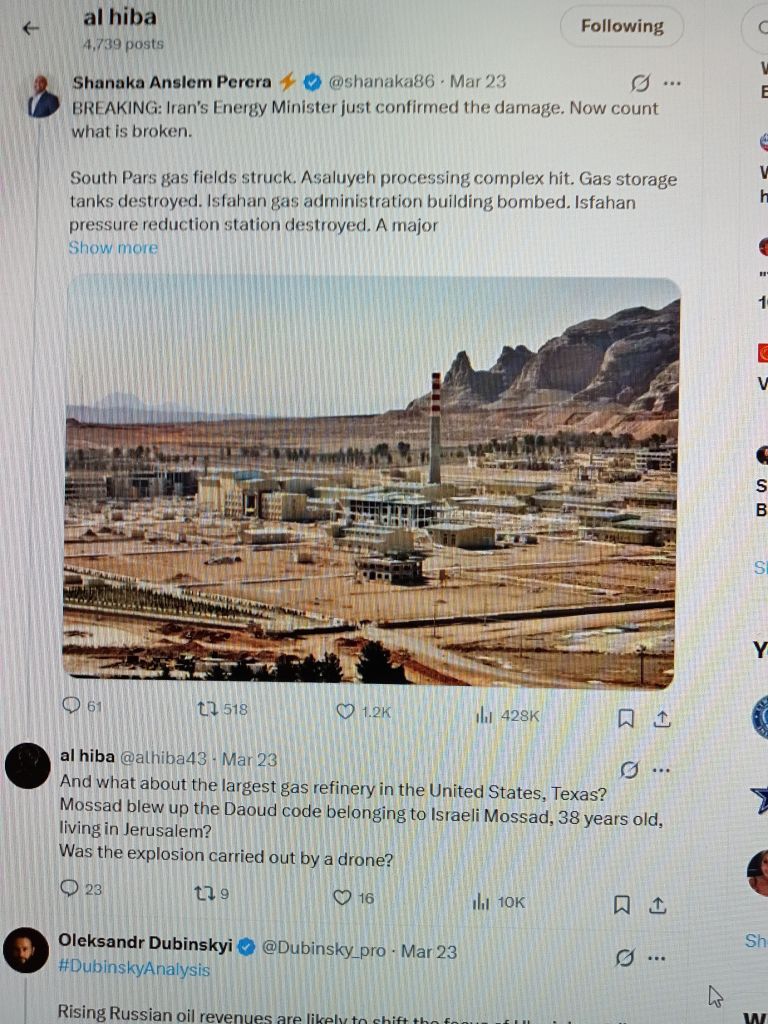
https://platform.twitter.com/widgets.jsAnd what about the largest gas refinery in the United States, Texas?
— al hiba (@alhiba43) March 24, 2026
Mossad blew up the Daoud code belonging to Israeli Mossad, 38 years old, living in Jerusalem?
Was the explosion carried out by a drone?
I believe a cover up is actively taking place across the mainstream media!
The post you’re seeing from “al hiba” contains several claims that align with viral information currently spreading on social media.
Official investigators and local authorities have claimed to found no evidence to support the idea of a drone attack or Mossad involvement. Here is a direct breakdown of the facts regarding the claims in that post:
1. The “Drone” and “Sabotage” Claims
There is no evidence of a drone or any external attack.
- Official Investigation: The Jefferson County Sheriff’s Office and Valero have stated that the incident was an industrial accident. A report filed with the Texas Commission on Environmental Quality (TCEQ) on March 24 attributed the fire to an “unforeseeable release of process fluid” in Complex 2.+1
- Law Enforcement: Chief Deputy Donta Miller explicitly stated that the department is not investigating the explosion as a deliberate act.
- Source of Rumors: The “drone” theory emerged primarily from pro-IRGC social media accounts and regional news outlets like Al Mayadeen, which began pushing a sabotage narrative immediately following the blast as part of broader geopolitical tensions.
2. The “Daoud Code” / Mossad Reference
The mention of a “Daoud code” or a 38-year-old Mossad agent in Jerusalem is a common characteristic of disinformation campaigns.
Tactical Misinformation: During high-profile accidents, anonymous accounts often use specific-sounding names or “codes” to make a conspiracy theory feel more authentic or “insider-led.”
Shelter-in-Place Active
OILFIELD BUSINESS NETWORK EXCLUSIVE
PORT ARTHUR, Texas – A massive explosion rocked the Valero Port Arthur Refinery, the largest in the United States, early Monday evening, sparking a significant industrial fire and triggering extensive shelter-in-place orders for surrounding communities. While official sources are attributing the blast to a probable mechanical failure, the event has amplified an already volatile energy market.
The Incident and Emergency Response
The explosion occurred at approximately 6:30 p.m. CDT on March 23, centered in one of the refinery’s processing units. The shockwave was felt miles away, rattling windows across Port Arthur and neighboring towns like Groves and Nederland. Immediately following the blast, a substantial fire erupted, sending columns of thick, black smoke into the sky.
Refinery emergency personnel, supported by mutual aid from surrounding industrial fire departments, engaged the blaze. Valero quickly confirmed that all 770 plant employees had been accounted for, and remarkably, no injuries were reported among staff.
Local Impacts: Shelter-in-Place and School Closures
In response to potential air quality concerns, the Port Arthur Office of Emergency Management, led by Mayor Charlotte Moses and Sheriff Zena Stephens, issued a Shelter-in-Place order. This order remains active as of Tuesday morning for the west side of Port Arthur, Sabine Pass, and Pleasure Island.
Residents are advised to stay indoors, seal windows and doors, and turn off air conditioning systems until an “All Clear” is given. The order was issued primarily to prevent respiratory irritation from the heavy smoke plume.
Furthermore, Sabine Pass ISD has canceled classes for Tuesday, March 24, as a direct result of the ongoing situation and travel disruptions. Major thoroughfares, including State Highways 82 and 87, experienced temporary closures, complicating traffic flow.
Investigation Underway: Sabotage Claims vs. Industrial Failure
The timing of this incident is particularly striking, occurring amidst extreme global oil market volatility and heightened geopolitical tensions involving Iran. Almost immediately following the explosion, online channels and social media accounts linked to Iranian interests began celebrating the event, some labeling it as a “strike” or “sabotage.”
However, local and state officials have strongly push back on this narrative. Jefferson County Sheriff Zena Stephens has consistently stated that the preliminary evidence points squarely to an industrial heater malfunction as the likely cause.
There is currently no confirmation from any official U.S. law enforcement or intelligence agency of external sabotage or intelligence involvement. The Texas Commission on Environmental Quality (TCEQ) is on-site with air monitoring equipment, and full investigations by Valero and relevant federal safety agencies will commence once the scene is fully secured.
Market Implications and Outlook
As the single largest refinery in the nation, with a total throughput capacity of 435,000 barrels per day, any prolonged disruption at the Port Arthur facility sends immediate ripples through the global energy market. Prices spikes, which were already elevated, saw further volatility following the news.
Oilfield Business Network will continue to track this critical developing story. We are awaiting the official results of the TCEQ air monitoring and the formal lifting of the shelter-in-place order. While the facility’s overall operations are being assessed, the initial confirmation of zero casualties among staff is a significant relief.
For continued, in-depth analysis on how this incident affects the oilfield services sector, supply chain dynamics, and regulatory responses, keep your browser tuned to OilfieldBusinessNetwork.com.
high-pressure water from on-site emergency vehicles can be seen directed at the flames, illustrating the intense ongoing fire suppression efforts that characterized the immediate response. .
Lack of Evidence: No credible news agency, intelligence organization, or government official has verified the existence of a “Daoud code” or any operative linked to this event.
 Oilfield Business Network & Oilfield Association
You must be logged in to post a comment.