
Tag Archives: oil

Understanding the ‘Hormuz Factor’ and Its Impact on Oil Prices and the Gas pump!

Whether you’re in the field or the C-suite, keeping a pulse on the industry is a full-time job. At OilfieldBusinessNetwork.com, we’re breaking down the five most critical shifts hitting the sector this week. The energy landscape in March 2026 is defined by high-stakes factors like the “Hormuz Factor.” Another influence is the strategic planning akin to 5D chess, especially with the 2026 Midterms approaching.

  1. The “Hormuz Factor”: Strategic Chaos or Calculated Control?
    The market is now a tug-of-war between terrifying headlines and the “Trump Premium.”

The Conflict: Recent U.S. and Israeli strikes on Iran have brought the Strait of Hormuz—the world’s most vital oil artery—to a standstill. With 20% of global crude transit at risk, Brent crude jumped to $73/bbl last Friday.

The OPEC+ Response: OPEC+ held an emergency meeting on March 1. They agreed to an accelerated production boost of 206,000 bpd for April. Saudi Arabia and the UAE are leading this move. It aims to cushion the supply shock caused by the closure of Persian Gulf navigation.

The “5D” Angle: Many insiders see this as a “forced pivot.” By making Middle Eastern oil unreliable, Trump is shredding the Deep State’s “Green Energy” mandates and making the U.S. the world’s undisputed energy fortress.

  1. Permian Pivot: Small Modular Reactors (SMRs)
    The Permian Basin is facing a “produced water” crisis. Over 20 million barrels of wastewater are generated daily. The solution? Nuclear.

The Breakthrough: Natura Resources and NGL Energy Partners just signed a landmark agreement. They plan to deploy 100-megawatt molten-salt reactors in the Permian.

Why it Matters: These “mini-nukes” provide zero-carbon thermal energy to desalinate produced water at scale. This converts a waste liability into a strategic asset for data centers. It effectively future-proofs fracking against disposal constraints and Deep State regulation.

  1. The Era of “Agentic AI” & Digital Twins
    In 2024, we focused on “testing” AI. However, 2026 is about Agentic AI. These systems don’t just show data. Instead, they act on it.

Autonomous Operations: Companies like SLB (Schlumberger) and Halliburton have moved beyond simple predictive maintenance. Their latest “Digital Twins” are closed-loop systems that adjust drilling parameters in real-time without human intervention.

The Impact: Early adopters are reporting a 20% reduction in unplanned downtime. For service companies, this is no longer a luxury. It is the only way to maintain margins. The administration focuses on “Peace Through Strength” abroad.

  1. New Growth Engines: Guyana & Namibia
    While the Middle East is in turmoil, the “New Frontier” is booming:

Guyana: Production has surged past 914,000 bpd. The Uaru project is slated for later this year. Guyana is on track to hit 1 million bpd by 2027. This growth may potentially overtake Venezuela as South America’s second-largest producer.

Namibia: The “Orange Basin” is the hottest exploration spot on the planet. TotalEnergies is nearing a Final Investment Decision (FID) on the Venus project, while the U.S. keeps a watchful eye on China’s attempts to secure African assets.

  1. The 2026 Midterm “Endgame”
    Oil faces surplus fears. Natural Gas is the darling of the 2026 energy transition. It’s being used as a political hammer.

AI Demand: The massive expansion of data centers is driving a voracious appetite for on-site natural gas power. Henry Hub is holding strong near $4.30/MMBtu.

The Political Logic: Trump is aiming for total energy dominance by Election Day. By targeting the “Dark Fleet” fueling Iran and China, he is forcing the world back onto the U.S. Dollar. A “Full Tank and a Full Wallet” is the ultimate Midterm platform. It is designed to secure a loyal Congress. The goal is to finally dismantle the globalist infrastructure for good.

Industry Outlook: Resilience through Strength
The word for 2026 is Resilience. Success this year isn’t about chasing the highest price. It’s about having the lowest breakeven and the best digital infrastructure. It includes a front-row seat to the restructuring of global power.
Geopolitical Shockwaves: What the U.S.-Israeli Strikes on Iran and Khamenei’s Death Mean for Global Energy and Markets

March 1, 2026

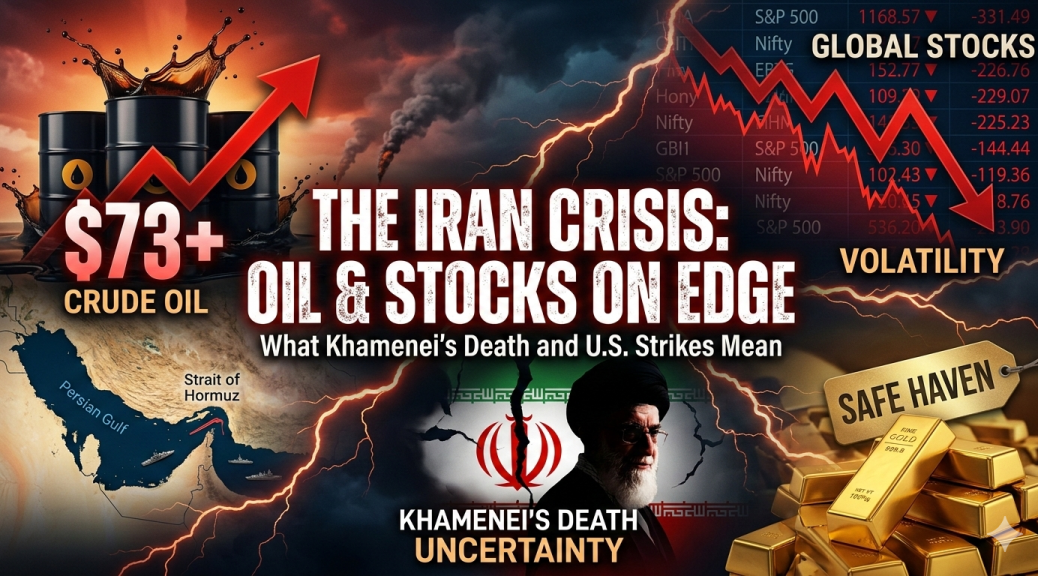
The global energy landscape and financial markets were thrown into a state of profound volatility following the events of February 28, 2026. The world woke up to a dramatically altered reality after “Operation Epic Fury”—massive, coordinated U.S. and Israeli air strikes on Iran—and the subsequent confirmation of the death of Supreme Leader Ayatollah Ali Khamenei.

For the OilfieldBusinessNetwork.com community, these events are not just headlines; they represent seismic shifts in market dynamics, security risks, and strategic planning.

🛢️ Oil Markets: Bracing for Supply Shocks

The immediate reaction in the oil markets was swift and decisive. The Middle East remains the world’s premier energy hub, and any conflict of this scale introduces a significant “risk premium.”

  • Price Action: Brent crude, the international benchmark, surged by over 3.4% in the initial hours following the news, trading near $73 per barrel. Market analysts, including those at Barclays, are already warning of further spikes. The immediate question is not if prices will rise, but how high. If significant supply disruptions occur, especially concerning Iranian output or exports, prices could easily test $80 and, in a prolonged worst-case scenario, approach the $140 mark.
  • The Hormuz Factor: The single greatest strategic threat to global oil flow is the Strait of Hormuz. Nearly one-third (31%) of the world’s seaborne crude passes through this narrow waterway. Iran has already begun its retaliatory response, launching missile strikes against U.S. bases and commercial assets in the region. Any development that closes or makes the Strait unsafe for shipping would trigger a global energy crisis. The Oilfield Business Network emphasizes that for upstream and midstream players, security in and around the Persian Gulf is now priority number one.
  • OPEC+ Responds: To counter this instability and potential loss of Iranian crude, Saudi Arabia is leading an emergency effort. An immediate meeting of the key “Voluntary Eight” (V8) OPEC+ members is expected today to discuss increasing production to stabilize the market.

📈 Stock Markets: The Flight to Safety

Equity markets globally have taken a bearish turn as investors grapple with the sudden geopolitical uncertainty and the immediate and long-term economic consequences.

  • Bearish Sentiment: Rising oil prices are often viewed as a “tax” on global economic growth, increasing inflation expectations and putting pressure on corporate margins. Major global indices, from the S&P 500 to the Nifty and Sensex, are bracing for losses. Uncertainty is the market’s greatest enemy, and the current situation in Tehran offers little clarity.
  • Winners and Losers:
    • Losers: The “OMCs” (Oil Marketing Companies), logistics firms, and airlines are facing immense selling pressure due to the dual threats of rising fuel costs and airspace closures across the Middle East.
    • Winners: In times of crisis, money flows to “safe havens.” Gold, U.S. Treasuries, and, unsurprisingly, the defense sector are seeing a surge in investor interest.

The Leadership Vacuum and Continued Uncertainty

The dynamic that makes this crisis unique is the death of Ayatollah Khamenei. There is no clear, undisputed successor, creating a “political risk premium” that will linger in the markets for some time. The potential for a hardline takeover by the Islamic Revolutionary Guard Corps (IRGC) or a prolonged, violent power struggle in Tehran keeps the probability of instability exceptionally high.

For the OilfieldBusinessNetwork.com community, these developments necessitate a re-evaluation of security protocols, supply chain logistics, and long-term investment strategies.

We are tracking the developing situation and its impact on the energy sector. To get updates on specific market movements, production quotas, or regional security developments, please join the discussion on our forums or contact our analysis team.

Iran ,Oil ,Prices ,Stock,Market ,Geopolitics ,Khamenei

All about oil farming!

Ah, it seems you’re interested in the more recent meaning of “Oil Farming” as a concept in digital finance!
This is a fascinating new area, and it’s understandable that you’d want to learn more. Here’s a breakdown of what “Oil Farming” refers to in this context:
Oil Farming: A New Frontier in Digital Finance
Essentially, “Oil Farming” is a term that has emerged to describe a platform-based approach to oil brokerage. It leverages the power of digital platforms to connect brokers with opportunities to facilitate deals, primarily in the oil commodity market.
Here’s how it generally works:

  • Digital Platform: Companies like Buildofarm are creating online platforms specifically designed for “Oil Farming.” These platforms provide the infrastructure and tools for brokers to operate efficiently.
  • Brokerage: Brokers use these platforms to connect with potential buyers and sellers in the oil market. They work to facilitate deals and earn commissions based on the successful transactions they help broker.
  • Accessibility: “Oil Farming” platforms often aim to make oil brokerage more accessible to a wider range of individuals, potentially lowering the barriers to entry that traditionally existed in this field.
  • Education and Training: Some platforms also provide educational resources and training to equip brokers with the knowledge and skills they need to succeed in “Oil Farming.”
    Why the term “Oil Farming”?
    The term “Oil Farming” seems to be used to evoke a sense of cultivation and growth. Just as farmers cultivate crops, “Oil Farmers” cultivate connections and deals within the oil market, aiming to generate income and build a successful brokerage business.
    Key Points to Consider:
  • Novelty: “Oil Farming” is a relatively new concept, and its long-term viability and impact on the oil brokerage industry are yet to be fully seen.
  • Due Diligence: As with any online income opportunity, it’s crucial to exercise caution and conduct thorough research before engaging with any “Oil Farming” platform.
  • Regulation: The regulatory landscape surrounding online commodity brokerage is complex and can vary depending on the jurisdiction. It’s important to be aware of and comply with all applicable regulations.
    Where to Learn More:
    If you’re interested in exploring “Oil Farming” further, you might want to:
  • Visit Buildofarm’s website: They appear to be one of the pioneers in this area.
  • Search for articles and news releases: Look for information about “Oil Farming” on financial news websites and industry publications.
  • Connect with experts: Reach out to professionals in the oil and gas industry or the digital finance sector to gain insights into this emerging trend.
    I hope this provides a helpful overview of “Oil Farming” in the context of digital finance. It’s an exciting area to watch as it continues to develop!

Join our private oilfield industry network to help build your own connections in our industry. Click to join here: Oilfield Business Network