Tag Archives: Trump

Geopolitical Tensions and Rising Gas Prices

The impact on the average person in the USA would be immediate and tangible. This is due to the current geopolitical landscape. It also relates to the concept of a “Hormuz Factor.” This term refers to potential instability or conflict in the Strait of Hormuz. It would be felt most acutely when they pull up to the gas pump. The global oil market is a complex machine, and the Strait of Hormuz is one of its most critical gears. Any disruption here, whether real or perceived, ripples across the entire globe with astonishing speed. It directly affects supply, cost, and ultimately, the daily lives of consumers.

How Global Turmoil Hits Local Pumps

You must first grasp the connections in oil supply chains to understand the impact of a distant crisis on local fuel prices. Comprehending market psychology is also essential. The Strait of Hormuz is a narrow passage that acts as the world’s primary choke point for oil transit. Approximately one-fifth of the world’s total oil consumption flows through this strategic waterway daily. Even minor instability in this region does more than threaten the supply for specific nations. It raises alarm bells for the entire global market. This creates a domino effect that lands at the neighborhood gas station.

1. Market Panic and Speculation

The fastest impact on gas prices from a major geopolitical event in the Hormuz Strait, like a blockade or attack, comes from market reaction. It is not caused by a physical shortage. Oil is traded in a global, futures-based market. This means the price is determined not only by the current supply and demand. It is also influenced by the anticipation of future supply and demand.

When instability occurs, oil traders and large-scale investors become worried. They fear that a major source of oil might be cut off or severely restricted. This “fear factor” causes them to immediately bid up the price of oil futures. They prefer buying oil today at a slightly higher price. They do this rather than risk paying much more later. Worse, they risk having no oil at all.

This speculative frenzy leads to an immediate spike in the crude oil price per barrel. This happens on global exchanges like West Texas Intermediate (WTI) and Brent crude. Because the price of crude oil accounts for roughly half of the cost of a gallon of gasoline, any increase on the global stage quickly affects local gas stations. They pay more to refill their tanks. This increased cost is then passed on to the consumer within days.

2. Physical Supply Disruption

The most critical impact is, of course, a genuine disruption in the physical supply of oil. If the flow of oil through the Strait of Hormuz is stopped or even significantly impeded, a massive shortfall in the global supply results. This shortfall cannot be easily or quickly replaced.

When such a critical amount of supply is removed from the market, global oil stockpiles are strained. Every oil-dependent country must compete on the open market. This includes the United States, despite its significant domestic production. They face a shrinking pool of available resources. The classic economic law of supply and demand takes hold: when supply plummets and demand remains, prices skyrocket.

In the 1970s, the oil embargoes provided a historic example. Supply disruption led to painful increases in cost. It caused rationing and long lines at American gas stations. Today, the global energy mix is more diversified, but oil is still paramount. The immediate and widespread nature of a Hormuz closure would lead to extremely severe price shocks. It could potentially drive prices to levels never before seen at American pumps.

3. Strategic Policy Responses

In the face of such a crisis, the U.S. government has tools to mitigate the impact, but they too have effects. One is the release of oil from the Strategic Petroleum Reserve (SPR). The SPR is a massive emergency stockpile of crude oil, but releasing it into the market is only a temporary measure. It can help bridge a short-term gap or dampen a sudden spike, but it cannot replace a sustained, massive disruption like a Hormuz blockage.

Furthermore, a U.S. strategy of “energy independence” relies on robust domestic production. In a crisis, the U.S. would attempt to ramp up its own production, but it’s not like turning on a faucet; the process of drilling and refining takes time. While this approach builds resilience, the global price mechanism still holds, as American-produced oil would be sought after by foreign buyers, putting upward pressure on domestic prices as well.

The Consequences for the Average Person

The ripple effects of high gas prices go far beyond simply paying more for a commute. They create a powerful “hidden tax” that hits families, workers, and the overall economy.

Increased Cost of Commuting and Daily Life

For the vast majority of Americans, a car is not a luxury; it is a necessity for life. Increased gas prices mean less money available for groceries, mortgage payments, childcare, and basic savings. This is particularly devastating for lower-income and middle-class families who have less flexible income. The simple act of driving to work, to school, or to a doctor’s appointment becomes significantly more expensive, stretching family budgets and reducing overall consumer spending.

Inflation: The Indirect Impact on All Goods

The cost of fuel is not just about what goes into a personal car. It is a critical component in the production and transport of almost every single good and service. High oil prices lead to high fuel surcharges for trucking companies, airlines, delivery services, and public transportation. This, in turn, drives up the cost of transporting food from farm to market, delivering Amazon packages, and heating homes. Businesses are forced to pass these increased costs on to the consumer to remain viable. This creates broad, inflationary pressure, making not only gas but also eggs, milk, new cars, and everything in between more expensive.

Economic Squeeze and Job Loss

High and persistent gas prices are a major drag on the entire economy. When consumers are forced to spend a larger portion of their paycheck on energy, they have less to spend on other things, like restaurant meals, travel, and retail goods. This reduction in overall consumer spending can lead to a significant slowdown in economic growth.

Industries that are highly sensitive to energy costs, such as manufacturing, tourism, and transportation, would face immediate financial strain. They might respond by reducing hours for workers, implementing hiring freezes, or in severe cases, laying off employees. The “Hormuz Factor” is not just a strategic concept; it’s a direct threat to the financial stability and livelihood of millions of American workers.

In conclusion, any scenario involving conflict or blockade in the Strait of Hormuz is not an abstraction of strategic geopolitical maneuvers. It is a tangible and immediate issue. For the average American, it poses a real challenge to their personal budget. It also directly impacts their way of life and is painful for them. It results in higher costs for basic needs. There is a reduction in quality of life. It is a potential threat to their economic security. This is experienced every single time they pull up to the pump to fill their tank.

Al Jazeera

www.aljazeera.com

How US-Israel attacks on Iran threaten the Strait of Hormuz, oil markets – Al Jazeera

Any instability in this important maritime route could rattle economic stability worldwide. So what is the Strait of Hormuz, and how will its closure impact …

EIA

www.eia.gov

The Strait of Hormuz is the world’s most important oil transit chokepoint – U.S. Energy Information Administration (EIA)

The Strait of Hormuz is the world’s most important oil transit chokepoint – U.S. Energy Information Administration (EIA) …

Discovery Alert

discoveryalert.com.au

Drone Incident in Strait of Hormuz Disrupts Global Oil – Discovery Alert

The strategic balance of global energy security rests precariously on a handful of maritime chokepoints where geopolitical tensions intersect with economic …

Charles Schwab

www.schwab.com

Crude Oil Futures Trading – Charles Schwab

CME Group provides access to E-mini Crude Oil and Micro Crude Oil futures contracts, which are 1/2 and 1/10 the size of a standard crude oil futures contract, …

YouTube

www.youtube.com

How Iran’s Oil Blockade Will Hurt 195 Countries – YouTube

How Iran’s Oil Blockade Will Hurt 195 Countries The closure of the Strait of Hormuz would have profound consequences for global trade and regional stability. …

Convenience.org

www.convenience.org

Factors That Affect Gas Prices | NACS

There are 42 gallons of oil per barrel. Retail gasoline prices move an estimated 2.4 cents per gallon for every $1 change in the price per barrel. Although …

Wikipedia

en.wikipedia.org

1979 oil crisis – Wikipedia

Due to memories of the oil shortage in 1973, motorists soon began panic buying, and long lines appeared at gas stations, as they had six years earlier. The …

Baker Institute

www.bakerinstitute.org

Oil Will Remain Central in Any Energy Transition Scenario – Baker Institute

… oil price volatility is a slippery game. Price movements are how the market signals supply, demand, trade, and inventories to adjust to changing …

The Guardian

www.theguardian.com

The strait of Hormuz: how could Iran close it and why does it matter to global trade?

The strait of Hormuz: how could Iran close it and why does it matter to global trade? This article is more than 8 months old. Iran’s parliament approved a …

Palestine Chronicle

www.palestinechronicle.com

EXPLAINER: Why the Strait of Hormuz Could Shape the War’s Outcome – Palestine Chronicle

The Strait of Hormuz has long been a stage for geopolitical pressure: During the Iran–Iraq War (1980–1988), attacks on tankers and mine warfare in the Gulf …

Understanding the ‘Hormuz Factor’ and Its Impact on Oil Prices and the Gas pump!

Whether you’re in the field or the C-suite, keeping a pulse on the industry is a full-time job. At OilfieldBusinessNetwork.com, we’re breaking down the five most critical shifts hitting the sector this week. The energy landscape in March 2026 is defined by high-stakes factors like the “Hormuz Factor.” Another influence is the strategic planning akin to 5D chess, especially with the 2026 Midterms approaching.

  1. The “Hormuz Factor”: Strategic Chaos or Calculated Control?
    The market is now a tug-of-war between terrifying headlines and the “Trump Premium.”

The Conflict: Recent U.S. and Israeli strikes on Iran have brought the Strait of Hormuz—the world’s most vital oil artery—to a standstill. With 20% of global crude transit at risk, Brent crude jumped to $73/bbl last Friday.

The OPEC+ Response: OPEC+ held an emergency meeting on March 1. They agreed to an accelerated production boost of 206,000 bpd for April. Saudi Arabia and the UAE are leading this move. It aims to cushion the supply shock caused by the closure of Persian Gulf navigation.

The “5D” Angle: Many insiders see this as a “forced pivot.” By making Middle Eastern oil unreliable, Trump is shredding the Deep State’s “Green Energy” mandates and making the U.S. the world’s undisputed energy fortress.

  1. Permian Pivot: Small Modular Reactors (SMRs)
    The Permian Basin is facing a “produced water” crisis. Over 20 million barrels of wastewater are generated daily. The solution? Nuclear.

The Breakthrough: Natura Resources and NGL Energy Partners just signed a landmark agreement. They plan to deploy 100-megawatt molten-salt reactors in the Permian.

Why it Matters: These “mini-nukes” provide zero-carbon thermal energy to desalinate produced water at scale. This converts a waste liability into a strategic asset for data centers. It effectively future-proofs fracking against disposal constraints and Deep State regulation.

  1. The Era of “Agentic AI” & Digital Twins
    In 2024, we focused on “testing” AI. However, 2026 is about Agentic AI. These systems don’t just show data. Instead, they act on it.

Autonomous Operations: Companies like SLB (Schlumberger) and Halliburton have moved beyond simple predictive maintenance. Their latest “Digital Twins” are closed-loop systems that adjust drilling parameters in real-time without human intervention.

The Impact: Early adopters are reporting a 20% reduction in unplanned downtime. For service companies, this is no longer a luxury. It is the only way to maintain margins. The administration focuses on “Peace Through Strength” abroad.

  1. New Growth Engines: Guyana & Namibia
    While the Middle East is in turmoil, the “New Frontier” is booming:

Guyana: Production has surged past 914,000 bpd. The Uaru project is slated for later this year. Guyana is on track to hit 1 million bpd by 2027. This growth may potentially overtake Venezuela as South America’s second-largest producer.

Namibia: The “Orange Basin” is the hottest exploration spot on the planet. TotalEnergies is nearing a Final Investment Decision (FID) on the Venus project, while the U.S. keeps a watchful eye on China’s attempts to secure African assets.

  1. The 2026 Midterm “Endgame”
    Oil faces surplus fears. Natural Gas is the darling of the 2026 energy transition. It’s being used as a political hammer.

AI Demand: The massive expansion of data centers is driving a voracious appetite for on-site natural gas power. Henry Hub is holding strong near $4.30/MMBtu.

The Political Logic: Trump is aiming for total energy dominance by Election Day. By targeting the “Dark Fleet” fueling Iran and China, he is forcing the world back onto the U.S. Dollar. A “Full Tank and a Full Wallet” is the ultimate Midterm platform. It is designed to secure a loyal Congress. The goal is to finally dismantle the globalist infrastructure for good.

Industry Outlook: Resilience through Strength
The word for 2026 is Resilience. Success this year isn’t about chasing the highest price. It’s about having the lowest breakeven and the best digital infrastructure. It includes a front-row seat to the restructuring of global power.

What are the best oilfield topics?

When it comes to oilfield topics, there are several areas that are important and relevant. Here are some of the best oilfield topics to consider:

  1. Exploration and Production Techniques: This topic covers various aspects of discovering and extracting oil and gas resources, including seismic surveys, drilling techniques, well completion methods, and reservoir management.
  2. Reservoir Engineering: Reservoir engineering focuses on the behavior and characteristics of oil and gas reservoirs. It involves topics such as reservoir characterization, reservoir simulation, enhanced oil recovery (EOR) methods, and production optimization.
  3. Drilling and Well Construction: This topic covers drilling operations, well design, wellbore stability, casing and cementing techniques, directional drilling, and well control. It also includes advancements in drilling technology, such as automation and rig instrumentation.
  4. Production Operations: Production operations involve the day-to-day activities of managing oil and gas production, including well testing, artificial lift methods, production optimization, asset integrity management, and production data analysis.
  5. Health, Safety, and Environment (HSE): HSE is a critical aspect of the oil and gas industry. Topics in this area include risk assessment, safety protocols, environmental impact assessments, waste management, and regulatory compliance.
  6. Offshore Oil and Gas: Offshore oil and gas exploration and production present unique challenges. Topics in this area include offshore drilling platforms, subsea systems, deepwater production techniques, offshore safety, and environmental considerations.
  7. Digitalization and Data Analytics: The oil and gas industry is embracing digital technologies and data analytics for improved decision-making and operational efficiency. Topics include the Internet of Things (IoT) applications, data management, predictive analytics, and artificial intelligence in oilfield operations.
  8. Sustainability and Renewable Energy: With the increasing focus on sustainability and the transition to renewable energy sources, topics related to renewable energy technologies, carbon capture and storage, energy transition strategies, and the future of the oil and gas industry are of great interest.
  9. Reserves and Resources Evaluation: Estimating and evaluating oil and gas reserves is crucial for investment decisions. Topics in this area include reserve estimation methods, resource classification systems, reserves auditing, and economic evaluation techniques.
  10. Geopolitics and Global Energy Markets: The oil and gas industry is influenced by geopolitical factors and global energy market dynamics. Topics include energy policies, energy geopolitics, market trends, supply and demand dynamics, and the impact of geopolitical events on oil prices.

These topics cover a wide range of areas within the oilfield industry and can provide a basis for in-depth research, analysis, and discussions.

Best Bed and Breakfast of Williston North Dakota

Bed & Breakfast in Williston Open 24 hours

Welcome to the River hacienda LLC (Bed and Breakfast of Williston, ND). We are here to offers overnight accommodation and breakfast and we always make sure you have the best accommodation possible while you explore. So why wait, Reserve now, pay at stay. www.instagram.com/tv/CtPvjGCKmSI/

River hacienda LLC (Bed and Breakfast of Williston, ND)

Close Menu

.com/

U.S. Shale Swings From Losses To Record Cash Flows | OilPrice.com

After years of plowing money into boosting production and thus depressing oil prices, the U.S. shale patch emerged from the pandemic-inflicted slump with unwavering capital discipline which, combined with $100+ oil, is paying off with record cash flows for American oil producers. The largest shale producers have left years of bleeding cash behind, focusing on returning capital to shareholders from the record cash flows they have been generating for several months now. As they report first-quarter figures these days, public companies vow continued disciplined spending and only modest production growth as “drill, baby, drill” is no longer shale’s primary goal. 

Investors, in turn, are rewarding the discipline—most of the 20 top-returning firms in the S&P 500 year to date are oil companies, including Occidental, Coterra Energy, Valero, Marathon Oil, APA, Halliburton, Devon Energy, Hess Corporation, Marathon Petroleum, ExxonMobil, ConocoPhillips, Chevron, Schlumberger, EOG Resources, and Pioneer Natural Resources. 

As a result of the highest oil prices since 2014 and capex discipline, the shale patch is on track for massive free cash flows of a combined $172 billion in 2022 alone, per Deloitte estimates cited by Bloomberg. By 2020, the shale industry had booked $300 billion in net negative cash flow in the 15 years since the first shale boom, Deloitte estimated back then.

Unlike in the previous upcycles, U.S. producers are now directing a large part of the record cash flows to boost shareholder returns with higher dividends, special dividends, and share buybacks. 

U.S. producers do not plan to abandon the newly-found capital discipline and will grow production only modestly, the top executives at most public shale producers said during the Q1 earnings calls this week. Many firms acknowledged the supply chain, inflationary, and labor constraints that could result in slower American oil production growth than the increase the EIA and analysts expect. Producers are also wary of the Biden Administration’s calls for only a short-term ramp-up in production amid otherwise negative comments on the oil industry, which undermines the firms’ visibility and willingness to plan higher investments in the medium term.  

“To say bluntly, the administration’s comments are certainly causing a lot of uncertainty in the market, both in the terms of regulatory taxation, legislation, and negative rhetoric toward our industry. And that creates uncertainty in our owners’, our shareholders’ minds about what the future of this industry really is,” Diamondback Energy’s CEO Travis Stice said on the earnings call this week. 

Diamondback Energy will keep its current oil production levels of 220,000 net barrels of oil per day, Stice said.

null

“While we believe that efficiently growing our production base is achievable over the long term, we do not feel that today

To finish reading this article click on the link to the original post.

https://oilprice.com/Energy/Energy-General/US-Shale-Swings-From-Losses-To-Record-Cash-Flows.html

US quietly backtracks on Russian oil ban

© Getty Images/Stephen SwintekRussian oil tanker The US has been vocal about restricting Russian oil imports, but sources say an actual ban is unlikely as it would further propel gasoline prices, which are already record high. On March 8, President Joe Biden announced his administration was banning Russian oil, natural […] The post US quietly…

US quietly backtracks on Russian oil ban

Restaurant review of the Dutch Plate

 This cozy restaurant has left the best impressions! Hospitable hosts, delicious dishes, beautiful presentation, wide list of wonderful desserts. I recommend to everyone! I would like to come back here again and again.

2. First time in Dutch Plate and YOU have to go! It’s the cutest little spot with amazing food. The veggie omelet is to die for. IT WAS FIRE!! The service we received was so amazing and we will definitely be back again. They made us feel welcomed and gave us an amazing experience.

3. It’s a great experience. The ambiance is very welcoming and charming. Amazing coffee, food and service. Staff are extremely knowledgeable and make great recommendations.

4. This place is great! Atmosphere is chill and cool but the staff is also really friendly. They know what they’re doing and what they’re talking about, and you can tell making the customers happy is their main priority. Food is pretty good, some Dutch classics and some twists, and for their prices it’s 100% worth it.

5. Do yourself a favor and visit this lovely restaurant in Campobello South Carolina. The service is unmatched. The staff truly cares about your experience. The food is absolutely amazing – everything we tasted melted in other mouths. Absolutely the best meal we had while in Campobello South Carolina. Highly recommend.

Trump signs executive orders on Keystone XL and Dakota pipelines

Get ready to go back to work pipeliners!  I know today was a day the my late brother Jasen Leach who worked for the Pipeliners Local Union 798 would have been very happy  to see today.

Connect and network with others in the oilfield industry on our facebook page                    Click here to sign up: https://www.facebook.com/OilfieldBusinessNetworks/

It’s official, Trump signed executive orders that will make it easier for TransCanada to construct the Keystone XL pipeline and for Energy Transfer Partners to build the final uncompleted portion of the Dakota Access pipeline ,according to which the US will renegotiate terms on the two pipelines.

Trump said “if the US build pipelines, the pipes should be made in the US” and added that “order streamlines cumbersome manufacturing regulations.” He called the regulatory process a “tangled up mess.”Trump told  also told reporters in the Oval Office that the moves on the pipelines will be subject to the terms and conditions being renegotiated by the U.S.

EX President Barack Obama killed the proposed Keystone XL pipeline in late 2015, saying it would hurt American efforts to reach a global climate change deal. The pipeline would run from Canada to U.S. refineries in the Gulf Coast. The U.S. government needs to approve the pipeline because it crossed the border.

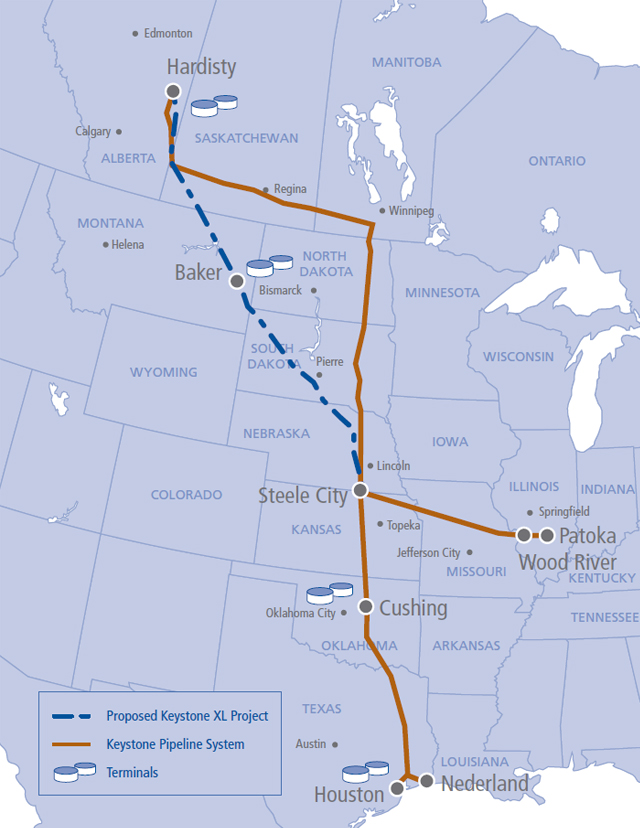
The Keystone XL would bring oil from Alberta, Canada, to Nebraska, where it would connect to an existing pipeline to bring the crude to Illinois. Former President Barack Obama refused to approve the cross-border project, saying the environmental review was not adequate in light of its route through the Sandhills ecosystem in Nebraska.

Keystone XL pipeline route, source: TransCanada

1485269786_Transcanada-keystone-xl-map.jpg

More details from Bloomberg:

Keystone was rejected under former President Barack Obama. Trump’s move on Energy Transfer Partners LP’s 1,172-mile Dakota Access project aims to end a standoff that has stalled the $3.8 billion project since September, when the Obama administration halted work on land near Lake Oahe in North Dakota.

The moves, taken on Trump’s fourth full day in office, mark a major departure from the Obama administration’s handling of the controversial oil pipelines. The steps vividly illustrate Trump’s plan to give the oil industry more freedom to expand infrastructure and ease transportation bottlenecks.

source: http://www.cnbc.com/ Legal challenges ahead

Both projects could still face challenges, according to Bruce Huber, an associate professor of law at the University of Notre Dame who specializes in environmental, natural resources and energy law.

The Keystone XL pipeline requires state approval, and Nebraska landowners fought a yearslong legal battle with TransCanada over the project. The company withdrew its application with the state’s Public Service Commission in November 2015 after the State Department decision.

Nebraska activists are likely to renew their protests, Huber said.

Trump has less room to maneuver when it comes to the Dakota Access pipeline, he added. The executive order “directs agencies to expedite reviews and approvals for the remaining portions of this pipeline,” White House press secretary Sean Spicer clarified during Tuesday’s news briefing.

Should the Army Corps of Engineers’ current environmental review pave the way for a new route, that plan will likely to face a lawsuit, Huber said.

“Any time you make an environmental analysis there’s always room for a lawsuit on whether the review was complete enough,” he said.

“If he truncates the process or speeds up the process, it just means that lawsuit will happen faster.”